Does oral micronized progesterone reduce night sweats during perimenopause? A Canadian randomized trial offers a more qualified answer than a simple yes or no. Its primary outcome—a daily score combining the frequency and intensity of hot flashes and night sweats—did not significantly favor progesterone over placebo. However, end-of-treatment questionnaires found greater perceived improvements in night sweats and sleep quality among participants assigned progesterone.
These findings are not contradictory: the measures asked different questions. The trial followed 189 women aged 35–58, averaging 49.9 years, through one untreated baseline month and three treatment months. Understanding what it establishes requires separating the primary diary outcome from secondary recollections, symptom-score units from episode counts, and this particular oral formulation from other progesterone products or routes.
Read this article by section
Study facts at a glance
Population and assignment: 189 perimenopausal participants were randomized: 93 to oral micronized progesterone and 96 to placebo; 176 completed the study. Source 1
Actual treatment exposure: One untreated baseline month preceded three months of treatment. The research arm used 300 mg orally at bedtime; this identifies the trial regimen, not a treatment instruction. Source 1
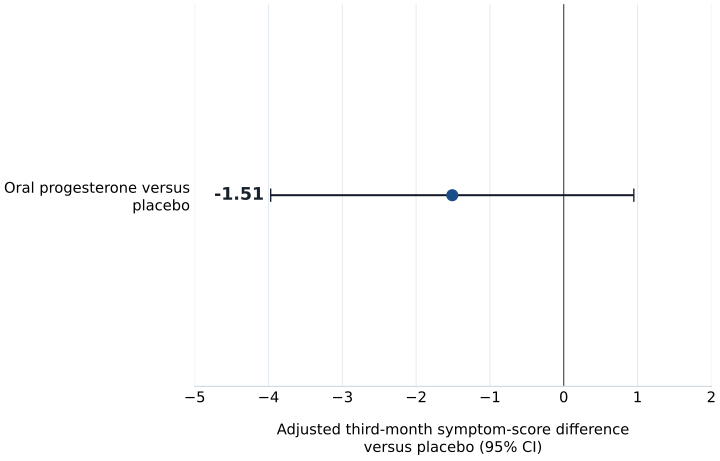
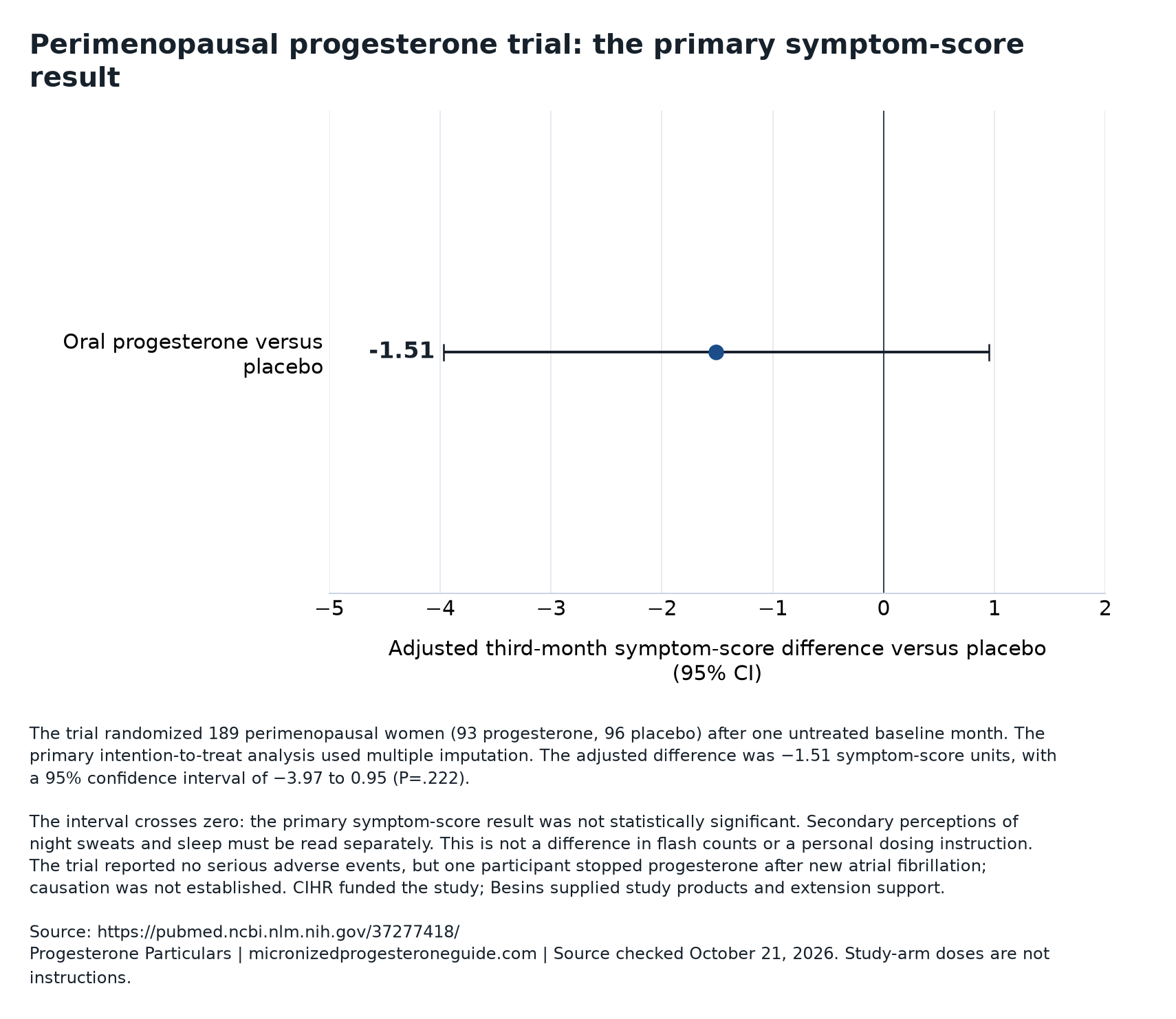
Primary result: The adjusted third-month VMS-score difference was −1.51 points, with a 95% confidence interval of −3.97 to 0.95 and P = .222: not statistically significant. Source 1
Secondary sleep findings: Participants reported greater perceived improvement in sleep quality and night sweats, but calendar-recorded sleep problems did not differ between groups in month three. Source 1
Safety and labeling: The trial reported no serious adverse events, but one progesterone participant stopped after new atrial fibrillation. The US Prometrium label does not list progesterone-alone hot-flash treatment or insomnia as approved indications. Source 1 Source 2
A trial centered on women still in the menopause transition
The study recruited community volunteers across Canada between January 2012 and April 2017. Eligibility required menstruation within the preceding year, bothersome vasomotor symptoms, and sufficient symptoms during a baseline recording period. Vasomotor symptoms, abbreviated VMS, are hot flashes and night sweats. Women who were already postmenopausal were excluded, making this a direct test in the transition rather than an extrapolation from later life.
At randomization, 63 participants were classified as early perimenopausal and 126 as late perimenopausal. Late transition included a cycle lasting at least 60 days or a skipped cycle during the preceding year. Nearly everyone—186 of 189—reported being awakened by night sweats at least twice weekly. Thus, although the primary score combined daytime and nighttime symptoms, nighttime disruption was particularly prominent in this population.
Participants were predominantly White, 57.1% had a university degree, and mean body mass index was 26.7. Depression screening excluded some women needing assessment or treatment; the sample should not represent every person with perimenopausal mood symptoms. Remote participation accounted for 93.1% of enrollment, broadening geographic access without making the sample demographically representative.
Read the underlying chart data: download CSV or download the source-labeled chart.
Four calendar months meant three months on medication
This was a double-blind, randomized, placebo-controlled trial coordinated at the University of British Columbia. Participants first recorded symptoms for one untreated month. Those remaining eligible were assigned to three months of oral micronized progesterone or identical placebo. The active research regimen consisted of three 100-mg capsules at bedtime daily. Describing the study as four months of progesterone exposure would therefore overstate treatment duration.
An independent statistician generated the allocation sequence, with randomization stratified by early or late perimenopause. A pharmacist assigned treatment through a password-protected system. These procedures helped keep assignment concealed, while identical capsules supported masking. Monthly contacts assessed well-being, adherence, and adverse events; returned capsule counts and calendar entries indicated adherence of 91.4% with progesterone and 84.4% with placebo.
Micronization reduces particle size and increases oral progesterone bioavailability, according to the product label. It does not itself establish symptom relief. The guide to what micronized progesterone means separates that physical property from efficacy, while the route comparison explains why an oral-capsule trial cannot automatically validate vaginal preparations, skin products, or compounded formulations.
What the daily symptom score actually measured
The primary endpoint was the third treatment month’s average daily VMS score, adjusted for baseline symptoms and perimenopause stage. Each day, participants recorded daytime hot-flash and nighttime sweat counts and intensity. The score multiplied frequency by intensity for each period and added the daytime and nighttime results. Higher values represented a greater combined symptom burden, not simply more episodes.
For illustration, two daytime episodes rated intensity 2 and one nighttime episode rated intensity 3 would yield 7 score points: four from daytime symptoms plus three from nighttime symptoms. This is an explanation of the scoring arithmetic, not a participant’s observed result. A one-point score change can arise through different combinations of frequency and intensity, so score points cannot be translated directly into episodes avoided.
At baseline, the mean score was 12.2, with a standard deviation of 11.3, showing substantial variation between participants. Mean frequency was 4.9 episodes per 24 hours. Eligibility also allowed entry based on recurrent nighttime awakenings, so not every participant needed the same daytime episode burden. That design made the trial relevant to troublesome night sweats but produced a heterogeneous symptom population.
The primary estimate favored progesterone, but remained uncertain
The adjusted third-month difference was −1.51 score points, with a 95% confidence interval from −3.97 to 0.95 and P = .222. Negative values favored progesterone. Because the interval included zero, the study did not demonstrate superiority over placebo on its prespecified primary endpoint. The unadjusted third-month means were 5.5 with progesterone and 7.1 with placebo; their 1.6-point gap is not the adjusted estimate.
The investigators treated a three-point advantage over placebo as a minimally important clinical difference. The confidence interval included an advantage of that size, but also included no advantage and a small difference favoring placebo. Consequently, the trial neither established a clinically important benefit nor ruled one out. The point estimate itself was smaller than the study’s three-point benchmark.
The symptom-score rate ratio was 0.79, with a 95% confidence interval of 0.54–1.15. Although its point estimate corresponds to a 21% lower modeled mean score, it is not a 21% reduction in a person’s risk of symptoms or a 21% chance of benefiting. Frequency and intensity analyzed separately were also nonsignificant.
Third-month adjusted outcomes: differences compare progesterone with placebo; negative differences favor progesterone.
| Outcome | Adjusted estimate, 95% confidence interval | Interpretation |
|---|---|---|
| Primary VMS score | −1.51 points; −3.97 to 0.95 | Not significant; meaningful benefit remained possible but unproven. |
| VMS frequency | −0.60 episodes per 24 hours; −1.50 to 0.29 | No demonstrated difference in episode count. |
| VMS intensity | −0.17 intensity units; −0.56 to 0.22 | No demonstrated difference in intensity. |
| Perimenopause interference | −6.65 questionnaire units; −12.11 to −1.18 | Secondary outcome favored progesterone. |
| Depression symptoms, PHQ-9 | −0.40 points; −1.57 to 0.77 | No demonstrated difference in depression score. |
Why improvement in both groups is not the treatment effect
Symptom scores declined in both treatment groups. Progesterone participants began at a mean score of 12.1 and ended at 5.5; placebo participants began at 12.3 and ended at 7.1. Those within-group changes describe experience over time, but they do not isolate what progesterone added. Randomization makes the between-group comparison the central test because natural changes and nonspecific study effects can occur in either arm.
Variability was evident even before treatment: 49 screened volunteers became ineligible because their baseline-month symptoms were insufficient. Selecting people when symptoms are troublesome can be followed by improvement as fluctuating symptoms return toward their usual level. That statistical tendency, called regression toward the mean, is one plausible contributor; the study cannot assign the placebo-group improvement to a single cause.
For readers interpreting personal symptom histories, the editorial implication is methodological: improvement after starting a product is not, by itself, proof that the product caused it. This trial’s daily records and placebo comparator were designed to address that problem. Its inconclusive adjusted comparison matters more than the larger before-and-after decline within the active arm.
Sleep and perceived night sweats told a different story
On the final treatment day, participants completed a perceived-change questionnaire comparing their experience with the beginning of the trial. Overall perceived night sweats improved more with progesterone than placebo, with P = .023; perceived sleep quality also favored progesterone, with P = .005. These results support further investigation of patient-experienced nighttime benefits, but they do not convert the primary VMS result into a positive trial.
Importantly, daily calendar ratings of sleep problems and anxiety did not differ between groups in month three. A retrospective judgment of overall sleep quality and a daily rating of sleep problems are related but distinct measurements. The divergence could reflect different aspects of sleep, recall, symptom awareness, or measurement sensitivity. This study did not establish which explanation accounts for the difference.
The investigators themselves noted a difficult unresolved question: better sleep might change awareness or recollection of night sweats without producing an equivalent change in physiological events. Conversely, less disruptive sweating could improve perceived sleep. Without objective sleep and sweat measurements, the direction cannot be resolved. The significant secondary interference score suggests a possible daily-life benefit, but its magnitude should not be mistaken for a percentage improvement.
Missing data and recruitment explain part of the uncertainty
The primary analysis followed intention-to-treat principles, retaining randomized participants in their assigned groups. Missing observations were handled with 100 multiple imputations: repeated, plausible replacements generated from available participant information, followed by combined analysis. This approach avoids treating every missing value as either success or failure, although its credibility still depends on whether the observed information adequately explains missingness.
A sensitivity analysis included 176 participants with at least seven days of calendar data at baseline and in month three. Its adjusted difference was −1.58 points, with a 95% confidence interval of −4.00 to 0.84 and P = .191. Its similarity to the primary result suggests that the broad conclusion was not simply an artifact of one missing-data approach.
Recruitment also fell short of the revised target. Initial planning assumed a smaller symptom standard deviation; a planned blinded reassessment found greater variability and increased the target to 228 completing participants. Ultimately, 189 were randomized and 176 completed. Calling the study underpowered describes limited precision, not hidden proof of effectiveness: a larger study could confirm benefit, show a smaller effect, or narrow the estimate around little difference.
The safety findings include an important discontinuation
Investigators collected adverse events monthly and assessed possible treatment relationships while blinded. They reported no serious adverse events. Nevertheless, one participant assigned progesterone developed atrial fibrillation, prompting her family physician to require treatment discontinuation. Both facts belong in the interpretation: the authors’ serious-event classification should not erase the cardiac event, and one event cannot establish that progesterone caused it.
Mild-to-moderate side-effect reports were numerically more frequent with progesterone: 22 versus eight with placebo. Nausea or gastrointestinal problems were reported eight times in the progesterone arm versus once with placebo; dizziness occurred once in each arm. The report did not find a statistically significant overall adverse-event difference, but that is not evidence that the treatments have identical tolerability.
Three months in 189 participants cannot quantify uncommon or long-latency harms. The current Prometrium label also warns about dizziness and drowsiness and lists contraindications including peanut allergy, unexplained genital bleeding, breast cancer history, thromboembolic disease history, and liver dysfunction. Its peanut-oil content illustrates why the exact formulation matters. Sedation is neither proof of restorative sleep nor evidence that an underlying sleep disorder has been treated.
The postmenopausal trial is supportive context, not a substitute
A separate randomized trial tested the same nominal oral progesterone dose against placebo in healthy women one to ten years after their final menstrual period. Unlike the perimenopause study, its primary VMS score significantly favored progesterone. The postmenopausal trial analysis examines why that result applies most directly to its selected postmenopausal population.
The earlier trial randomized 133 participants but analyzed 114 with baseline and treatment symptom data. Its adjusted advantage was 4.3 score points, not the 5.6-point difference obtained by subtracting the reported raw within-group changes. Differences in reproductive stage, baseline burden, selection, and analysis prevent a direct claim that progesterone works better after menopause. There was no head-to-head randomized comparison of the two populations.
For this comparison, the accessible evidence is the indexed primary postmenopausal report abstract, alongside the full perimenopausal research article and official labeling material. Funding was not identified in that abstract. In the perimenopausal trial, the Canadian Institutes of Health Research funded the work; Besins Healthcare International supplied progesterone and placebo and made a university donation supporting an additional recruitment year. Authors declared no competing interests.
Two separate progesterone trials asked related questions in different reproductive stages.
| Feature | Perimenopausal trial | Postmenopausal trial |
|---|---|---|
| Population | 189 randomized; ages 35–58; menstruation within one year | 133 randomized; ages 44–62; one to ten years after final menstruation |
| Intervention and comparator | 300 mg oral micronized progesterone at bedtime versus placebo | 300 mg oral micronized progesterone at bedtime versus placebo |
| Observation and exposure | One baseline month plus three treatment months | Four-week run-in plus 12 treatment weeks |
| Primary adjusted score difference | −1.51; 95% CI −3.97 to 0.95 | −4.3; 95% CI −6.6 to −1.9 |
| Analysis population | 189 in intention-to-treat analysis with imputation | 114 with run-in and on-treatment VMS data |
| Reported safety context | No serious adverse events reported; one atrial-fibrillation-related stop | Adverse-event discontinuations: eight active, four placebo; no serious cases reported |
Product approval and service claims answer separate questions
The US Prometrium label lists prevention of endometrial hyperplasia in postmenopausal women with a uterus receiving conjugated estrogen tablets, and treatment of secondary amenorrhea. It does not list progesterone-alone hot-flash treatment or insomnia. Hyperplasia means overgrowth of the uterine lining; evidence about preventing it is not evidence about night-sweat relief. The bioidentical progesterone and approval guide explains why molecular identity and approved use remain separate issues.
FDA announced labeling changes for an initial six menopausal hormone products in February 2026, including removal of certain risk statements from boxed warnings. That announcement does not mean every product label changed simultaneously or that all risks disappeared. The current Prometrium label retains substantial warnings and contraindications. Neither this short symptom trial nor the labeling update establishes universal long-term safety for progesterone alone.
Editorial interpretation: when comparing care arrangements, documentary clarity is more useful than treating this trial as a service endorsement. The Midi review and Evernow review offer starting points for checking written product and service terms, not evidence that either delivers this study’s formulation or outcomes. Trial findings do not transfer automatically to a provider, subscription, compounded preparation, or different administration route.
Questions about the evidence
Was this a positive trial for perimenopausal hot flashes and night sweats?
Not on its primary endpoint. The third-month combined VMS score did not significantly differ from placebo. Secondary perceived night-sweat, sleep-quality, and daily-life interference findings favored progesterone. Those signals justify further research but should be reported alongside, rather than substituted for, the inconclusive primary result.
Does a nonsignificant result mean progesterone had no effect?
No. The confidence interval included both no benefit and an advantage exceeding the study’s three-point clinical-importance benchmark. The evidence was too imprecise to distinguish those possibilities confidently. Equally, insufficient power does not establish that a larger trial would necessarily have been positive.
Did progesterone objectively improve sleep?
This trial found better perceived sleep quality on an end-of-treatment questionnaire, not an objective sleep-laboratory result. Calendar-recorded sleep problems did not differ in month three. It therefore cannot establish improved sleep architecture, explain the mechanism of perceived improvement, or demonstrate treatment of a sleep disorder.
Can these results be applied to progesterone creams or compounded capsules?
Not automatically. The study tested a specified oral micronized progesterone capsule regimen against identical placebo. Different routes, ingredients, and preparations can change exposure and tolerability. A shared hormone name, or the word micronized, does not demonstrate that another formulation reproduces the trial’s benefits or adverse effects.
What would a more decisive study need to resolve?
It would need enough participants for the variability observed here, a prespecified clinically meaningful primary outcome, and careful handling of missing records. Objective nighttime measurements could help distinguish reduced sweating from altered awareness during sleep. Longer follow-up and broader recruitment would improve information about durability, tolerability, and applicability.
What this evidence supports
The most defensible reading is an inconclusive primary perimenopausal VMS trial with potentially important secondary nighttime and daily-life signals. Randomization, masking, daily recording, strong retention, and a similar sensitivity analysis strengthen its contribution. The wide confidence interval, recruitment shortfall, differing sleep measures, and limited treatment duration leave substantial questions unresolved. Oral micronized progesterone merits further study in this population, but this evidence does not establish a reliable average reduction in the primary symptom score or a general insomnia indication.
Research access and limitations
This analysis uses the full perimenopausal research article, including its methods, results, corrected tables and funding disclosures; the indexed primary postmenopausal report abstract; and available official labeling and FDA material. It does not claim independent examination of all linked protocols, supplements, or participant-level data. The article notes a correction to questionnaire values in Table 2; the interpretation here uses the corrected report.
Documents behind the details
Read the source for the product, use and context it actually describes. A source type is not a rating of a provider.
- Oral micronized progesterone for perimenopausal night sweats and hot flushes a Phase III Canada-wide randomized placebo-controlled 4 month trial.Indexed primary study abstract and full research article · Checked 2026-10-21
- DailyMed — PROMETRIUM progesterone capsule, Acertis Pharmaceuticals LLCExact identified oral product labeling, updated July 23, 2026; text only, no package-image inspection. Ingredient, formulation and WHI study details are not assigned to a health-system prescription. · Checked 2026-10-21
- Oral micronized progesterone for vasomotor symptoms--a placebo-controlled randomized trial in healthy postmenopausal women.Indexed primary study abstract · Checked 2026-10-21
- FDA: First six menopausal hormone therapy label changes, February 12, 2026Regulatory announcement · Checked 2026-10-21