A trial of oral micronized progesterone offers a specific piece of evidence about postmenopausal hot flashes and night sweats. In 133 randomized participants, the treatment group had a better vasomotor symptom score than the placebo group after 12 weeks. But the headline number—a 4.3-unit adjusted difference—does not mean 4.3 fewer hot flashes daily. Understanding what researchers counted, who entered the study, and whose data reached the analysis changes how that finding should be read.
This analysis uses the indexed primary report abstract for the postmenopausal trial, the full research article for a separate perimenopausal trial, and available official US labeling and FDA material. The central distinction is between evidence of symptom benefit in a research setting and an approved indication for a particular product. Micronization, oral administration, menopausal stage, and the outcome scale each define a different boundary around the evidence.
Read this article by section
Study facts at a glance
Population: 133 selected healthy women, ages 44–62, were randomized 1–10 years after final menstruation. Source 1
Study exposure: The historical intervention was oral micronized progesterone 300 mg at bedtime versus placebo for 12 weeks, after a four-week run-in; this identifies the research arm, not dosing advice. Source 1
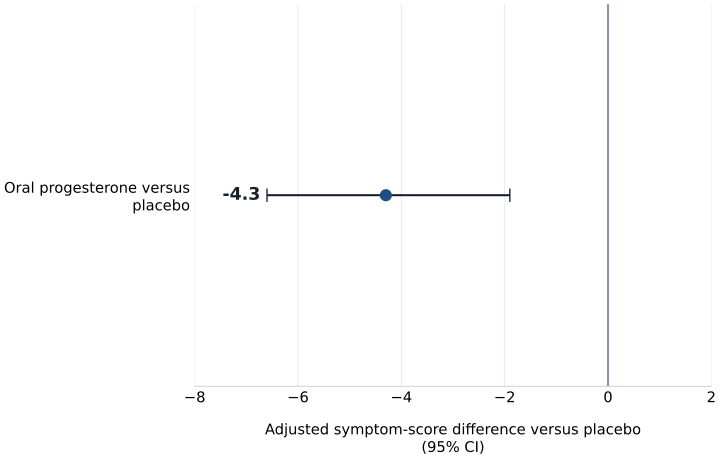
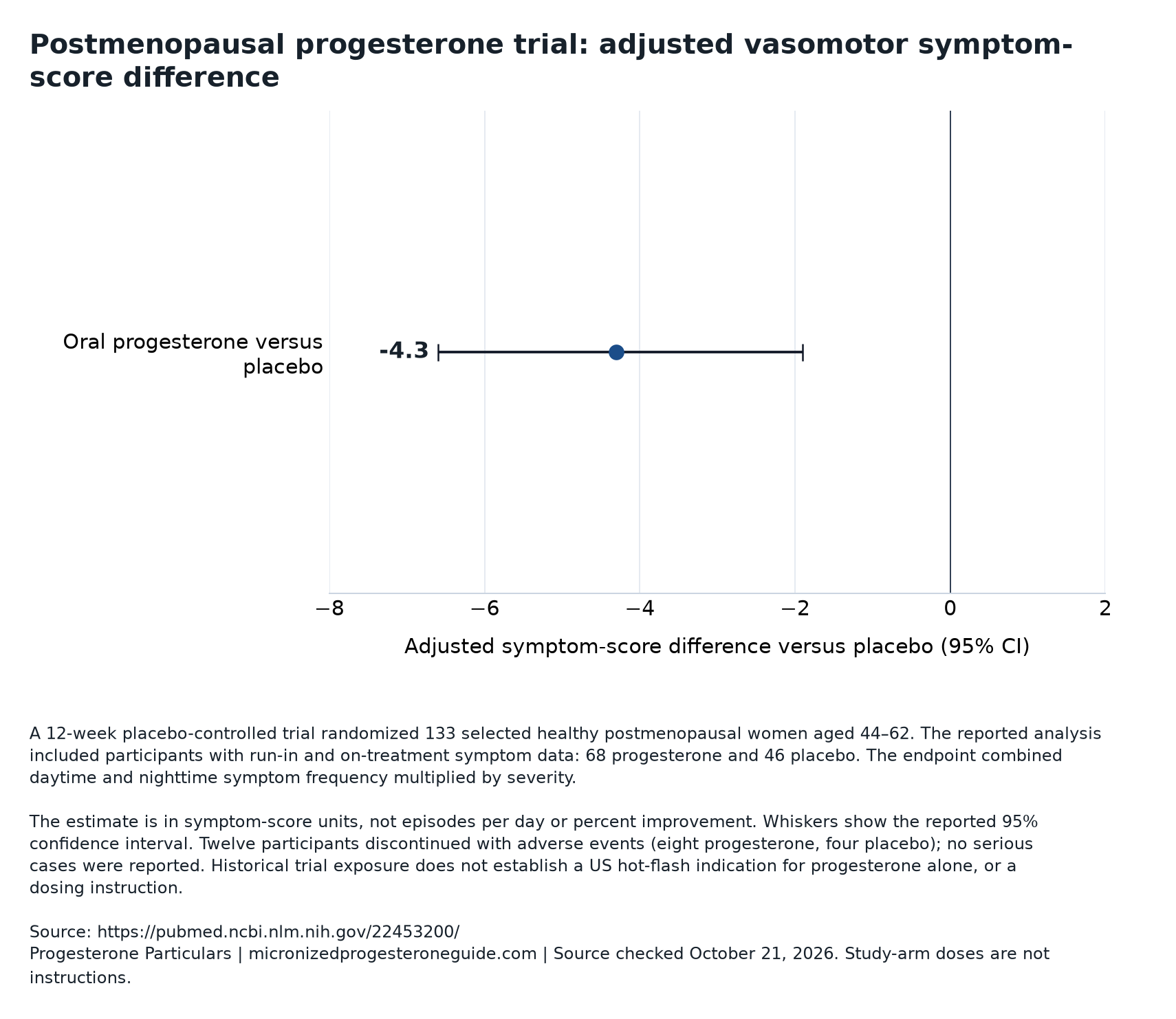
Primary finding: The adjusted between-group VMS-score difference was −4.3 units, with a 95% confidence interval of −6.6 to −1.9. Source 1
Analysis and tolerability: 114 participants contributed run-in and on-treatment symptom data. Adverse-event discontinuations numbered eight with progesterone and four with placebo; no serious cases were reported. Source 1
US label boundary: The current Prometrium label lists specified endometrial-hyperplasia prevention and secondary amenorrhea uses, not progesterone-alone treatment of hot flashes. Source 2
A selected population, not every woman after menopause
The postmenopausal study recruited community volunteers between 2003 and 2009. Participants had hot flashes or night sweats and were between one and 10 years beyond their final menstrual period. Their ages ranged from 44 to 62. This was therefore a study of symptomatic women relatively early after menopause, not a broad sample spanning all later ages or durations since menopause.
Eligibility also required favorable cardiovascular screening. Participants were nonsmokers, had a body mass index below 35, were nondiabetic, and had normal lipid and electrocardiogram findings. These conditions matter because they deliberately narrow the clinical population represented. A treatment effect observed here does not automatically describe women excluded by those screens.
The screening also shapes safety interpretation. A relatively healthy starting population has fewer opportunities to reveal problems associated with existing illness. The trial can inform a symptom question in its enrolled population while remaining poorly suited to estimating risks in people with cardiovascular disease, diabetes, or other characteristics not represented.
Read the underlying chart data: download CSV or download the source-labeled chart.
What the randomized comparison actually tested
The study was randomized, double-blind, and placebo-controlled. Researchers assigned 75 women to oral micronized progesterone and 58 to placebo. Random assignment supports a causal comparison by reducing systematic differences between treatment groups, while blinding limits the influence of knowing which treatment was received on symptom reporting and study interactions.
Participants first completed a four-week run-in, recording symptoms before the intervention. The treatment period lasted 12 weeks. The progesterone arm used 300 mg daily at bedtime. That amount and timing describe the historical research exposure; they are not instructions and do not establish a labeled hot-flash regimen.
The comparison was progesterone against placebo—not progesterone against estrogen, combined menopausal hormone therapy, or another active treatment. Consequently, the study does not rank those choices. Nor does one tested exposure establish whether lower amounts, intermittent schedules, or longer treatment would yield the same balance of benefit and adverse effects.
Micronization and the oral route are part of the evidence
Micronization is a physical formulation feature, distinct from the identity of the hormone. The official Prometrium label states that micronization increases progesterone's oral bioavailability—the amount available to the body after administration—although its absolute bioavailability is unknown. Our guide to what micronized progesterone means separates that formulation detail from broader product claims.
The trial studied oral micronized progesterone. It did not establish equivalent hot-flash effects for vaginal preparations, skin creams, or other delivery systems. The oral, vaginal, and skin progesterone guide explains why a shared ingredient name does not make routes interchangeable. Formulation and administration remain part of the question being tested.
Likewise, chemical similarity to progesterone produced by the body is not a clinical outcome. The label describes Prometrium's progesterone as chemically identical to ovarian progesterone, but that fact alone does not establish efficacy for every symptom or freedom from adverse effects. The distinctions in bioidentical progesterone and FDA approval are especially relevant when interpreting product descriptions.
The primary endpoint combined frequency with severity
Vasomotor symptoms, abbreviated VMS, include hot flashes and night sweats. Participants recorded daily frequency and severity, using a severity scale from one to four. The score added daytime frequency multiplied by daytime severity to nighttime frequency multiplied by nighttime severity. The primary endpoint was the average daily score during the final 28 treatment days, analyzed with adjustment for the run-in score.
An illustrative calculation shows why the units matter. Four daytime episodes rated two and two nighttime episodes rated three would produce a score of 14: eight daytime units plus six nighttime units. The same six episodes could generate a lower score if their severity decreased, even without a change in episode count. This is an explanation of the scale, not a reconstruction of any participant's diary.
At run-in, the group mean score was 17.0, with a standard deviation of 10.4; mean frequency was 6.8 episodes daily, with a standard deviation of 3.2. The spread shows substantial differences among participants. Neither the average score nor average frequency should be treated as the experience of every enrolled woman.
Three distinct quantities in the postmenopausal trial
| Measure | Reported value | Correct interpretation |
|---|---|---|
| Run-in VMS frequency | Mean 6.8 episodes per day | A count of symptom episodes, not a severity-weighted score |
| Run-in VMS score | Mean 17.0 units | A combined frequency-and-severity measure |
| Adjusted treatment contrast | −4.3 score units; 95% CI −6.6 to −1.9 | A between-group score difference, not 4.3 fewer episodes daily |
Reading the benefit without changing its units
The adjusted progesterone-versus-placebo difference was −4.3 VMS-score units. Negative values favored progesterone because lower scores meant fewer symptoms, less severe symptoms, or both. The 95% confidence interval extended from −6.6 to −1.9. It excluded zero, supporting a treatment difference on the prespecified primary outcome under the analysis used.
The interval also conveys uncertainty about magnitude. The data were compatible with a comparatively modest score advantage near 1.9 units as well as a larger advantage near 6.6 units. It is not a range of individual responses, and it does not predict the improvement a particular woman would experience. The abstract does not provide a responder proportion that could answer that different question.
Mean reductions were reported as 10.0 units with progesterone and 4.4 with placebo, with respective confidence intervals of −12.0 to −8.1 and −6.6 to −2.2 for the changes. Subtracting those reduction magnitudes gives 5.6, not 4.3. That arithmetic does not replace the reported adjusted contrast, which accounts for run-in scores. Neither figure is a percentage reduction or an episode count.
Why improvement with placebo belongs in the interpretation
The placebo group improved meaningfully on the study's numerical scale. That does not invalidate the progesterone result; it explains why a controlled comparison was necessary. If only the active group's before-and-after change were reported, readers could incorrectly attribute its entire improvement to the medicine rather than to all changes occurring during participation.
Interpretation: several processes could contribute to improvement in either arm, including symptom fluctuation and study participation. The abstract does not separate those contributions. The randomized between-group contrast is the more appropriate estimate of the treatment's additional effect within this design, rather than the active arm's total decline from baseline.
The final-28-day endpoint also describes a particular window. It summarizes symptoms near the end of 12 weeks rather than establishing when benefit began, whether every preceding week improved equally, or whether benefit persisted afterward. Those time-course questions require information beyond the primary estimate reported in the indexed abstract.
The analysis included 114 of 133 randomized participants
The abstract states that analysis included participants with VMS data during both run-in and treatment: 68 in the progesterone arm and 46 in the placebo arm. Those numbers total 114, leaving 19 randomized participants outside that stated analysis. It would therefore be inaccurate to describe the result as a complete analysis of outcomes from all 133 randomized women.
Expressed as transparent arithmetic, seven of 75 assigned progesterone and 12 of 58 assigned placebo were absent from the reported analysis set. These are analysis exclusions based on the stated data requirement, not necessarily the same thing as adverse-event withdrawals. The abstract does not supply enough participant-level information to equate the two categories.
Missing outcomes can matter if their absence relates to symptom response or tolerability. Randomization protects the original assignment process, but it cannot guarantee that a smaller analyzed group preserves every advantage of that process. The abstract does not establish the direction or size of any resulting bias, so the appropriate conclusion is uncertainty—not an assumption that missing participants either erase or strengthen the observed benefit.
Adverse-event withdrawals need the right denominator
Discontinuations associated with adverse events numbered eight with progesterone and four with placebo. Together, 12 of 133 randomized participants equal approximately 9%, the overall figure reported in the abstract. That 9% is not a separate rate for each treatment arm.
For clarity, dividing the arm-specific counts by the randomized denominators gives approximately 10.7% for progesterone and 6.9% for placebo. These are calculated descriptive proportions, not the abstract's separately reported arm rates or proof of a statistically established difference. The indexed abstract does not identify the individual adverse effects behind those withdrawals.
No serious cases were reported. That observation is useful but limited by the short follow-up and selected population. Separately, the current Prometrium label warns about dizziness and drowsiness and identifies peanut oil as an ingredient contraindicated in people with peanut allergy. Label safety information complements the trial; it should not be presented as though each labeled reaction occurred in this particular study.
The perimenopausal trial answered a different question
A separate Canadian randomized trial enrolled 189 perimenopausal women who had menstruated within the preceding year. Their mean age was 49.9 years. After one untreated baseline month, participants received oral micronized progesterone 300 mg at bedtime or placebo for three months. The perimenopause trial analysis examines why its primary and perceived-change results need separate treatment.
Its adjusted third-month VMS-score difference was −1.51, with a 95% confidence interval of −3.97 to 0.95. Unlike the postmenopausal result, that interval included zero. It also included a potentially important benefit, so the finding was inconclusive rather than evidence that all worthwhile effects were excluded. Perceived night-sweat and sleep-quality improvements were secondary findings; calendar-recorded sleep problems did not differ at month three.
This trial reported no serious adverse events, but one progesterone participant stopped on a physician's instruction after new atrial fibrillation. That does not establish causation. Mild-to-moderate side-effect reports numbered 22 versus eight. Its funding came from the Canadian Institutes for Health Research, with study products and extension support from Besins. The postmenopausal abstract does not identify its funding, and this separate disclosure cannot be transferred to it.
Why the two progesterone trials should not be merged into one finding
| Feature | Postmenopausal trial | Perimenopausal trial |
|---|---|---|
| Population | 133 randomized; 1–10 years after final menstruation | 189 randomized; menstruation within the preceding year |
| Primary score contrast | Adjusted difference −4.3; 95% CI −6.6 to −1.9 | Adjusted difference −1.51; 95% CI −3.97 to 0.95 |
| Analysis population | 114 with run-in and on-treatment VMS data | Intention-to-treat analysis using multiple imputation for missing data |
| Primary interpretation | Evidence of a lower VMS score with progesterone | Superiority not established; meaningful benefit not excluded |
Symptom research and the current US label remain separate
The current US Prometrium label lists prevention of endometrial hyperplasia in postmenopausal women with a uterus receiving conjugated estrogen tablets, and treatment of secondary amenorrhea. It does not establish an indication for progesterone-alone hot-flash treatment or insomnia. Its endometrial evidence concerns uterine-lining outcomes with estrogen, not the symptom endpoint examined here.
FDA announced labeling changes for an initial six menopausal hormone products in February 2026. That announcement does not mean all risks disappeared. The current Prometrium label retains contraindications and warnings, including those concerning thromboembolic disease, breast cancer history, unexplained genital bleeding, and liver disease. Evidence from estrogen plus medroxyprogesterone acetate should not be misidentified as a trial of micronized progesterone alone.
Editorial interpretation: a study supports a defined formulation and outcome, not a provider's service or contract. Readers checking documentary terms can use the CoreAge Rx review or Cost Plus Drugs review as prompts to verify product identity and pharmacy details. These links do not establish availability of the studied product, condition-specific care, or comparable outcomes. The same caution applies to compounded preparations: a shared hormone name is not evidence of equivalent clinical performance.
Questions about the evidence
Did progesterone prevent 4.3 hot flashes per day?
No. The 4.3-unit figure was an adjusted difference in a score combining daytime and nighttime frequency with severity. A score can improve through fewer episodes, milder episodes, or both. The primary result cannot be translated directly into a daily episode reduction.
Does this establish that progesterone works better than estrogen?
No. The comparator was placebo, not estrogen or estrogen-plus-progestogen therapy. The study supports an additional score benefit over placebo in its selected population. It provides no head-to-head estimate of relative efficacy, tolerability, or long-term outcomes against an active treatment.
Does the study prove a sleep benefit after menopause?
Its reported primary endpoint was the combined vasomotor symptom score, not a dedicated sleep endpoint. Night sweats contributed to that score, but fewer or milder night sweats are not interchangeable with demonstrated treatment of a sleep disorder. The separate perimenopausal study's perceived sleep-quality finding should not be imported as a postmenopausal result.
Were adverse effects absent because no serious cases were reported?
No. Eight progesterone participants and four placebo participants discontinued with adverse events. The abstract's absence of serious cases describes a short, selected trial; it does not establish absence of adverse effects or long-term risk. Current product labeling supplies additional safety information that the trial alone cannot provide.
Is the research regimen an FDA-approved hot-flash dose?
No. The historical 300-mg oral study arm identifies what researchers tested. The current Prometrium label does not list progesterone-alone hot-flash treatment as an indication. An efficacy finding and a labeled indication are different forms of evidence, and neither should be substituted for the other.
What this evidence supports
The postmenopausal trial provides randomized evidence that oral micronized progesterone lowered a combined hot-flash and night-sweat score more than placebo over 12 weeks in selected healthy women early after menopause. Its strongest numerical finding is the adjusted −4.3-score-unit contrast, not an episode reduction or an individual guarantee. Missing outcome data, limited duration, and the narrow population restrict the conclusion. Longer studies with complete outcome accounting, clearer responder measures, and active comparators would help establish durability, practical magnitude, and comparative tolerability.
Research access and limitations
The postmenopausal analysis relies on the indexed primary report abstract, not examination of its full protocol or supplements. The separate perimenopausal full article and current official labeling provide context but do not fill missing details in the postmenopausal report.
Documents behind the details
Read the source for the product, use and context it actually describes. A source type is not a rating of a provider.
- Oral micronized progesterone for vasomotor symptoms--a placebo-controlled randomized trial in healthy postmenopausal women.Indexed primary study abstract · Checked 2026-10-21
- DailyMed — PROMETRIUM progesterone capsule, Acertis Pharmaceuticals LLCExact identified oral product labeling, updated July 23, 2026; text only, no package-image inspection. Ingredient, formulation and WHI study details are not assigned to a health-system prescription. · Checked 2026-10-21
- Oral micronized progesterone for perimenopausal night sweats and hot flushes a Phase III Canada-wide randomized placebo-controlled 4 month trial.Indexed primary study abstract and full research article · Checked 2026-10-21
- FDA: First six menopausal hormone therapy label changes, February 12, 2026Regulatory announcement · Checked 2026-10-21